
Introduction
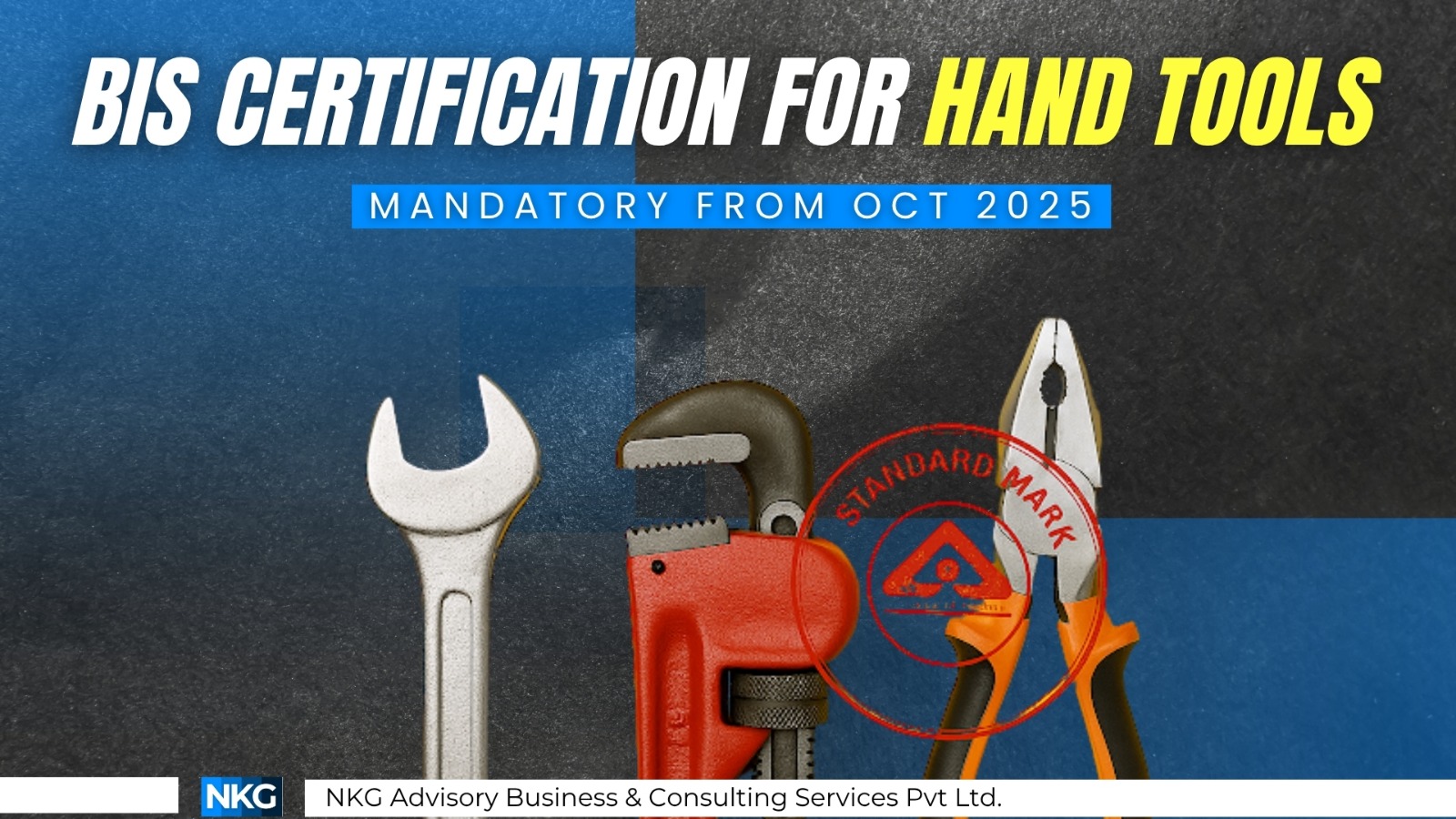
The Indian government has taken a firm step toward standardizing product quality and safety in the tools sector. With the notification of the Hand Tools Quality Control Order 2025, it is now mandatory for manufacturers and importers to obtain BIS certification for hand tools listed under specific Indian Standards.
If you’re dealing with pipe wrenches, pliers, or spanners, this blog walks you through the new compliance rules, implementation dates, and the exact process to get your products BIS-certified.
What is the Hand Tools Quality Control Order 2025?
The Hand Tools Quality Control Order (QCO), 2025 was issued by the Department for Promotion of Industry and Internal Trade (DPIIT) and published in the Gazette on 24 July 2025. It supersedes the 2024 version and brings 9 specific tools under mandatory BIS certification, under the framework of the Bureau of Indian Standards (BIS) Act, 2016.
All covered tools must now comply with relevant Indian Standards for hand tools and carry the Standard Mark under Scheme-I of the BIS (Conformity Assessment) Regulations, 2018.
Who Must Comply?
This QCO applies to:
- Manufacturers of hand tools within India
- Importers bringing tools into India for sale
- OEM suppliers exporting to Indian brands
Exemptions:
- Products manufactured exclusively for export
- Up to 200 units/year imported strictly for R&D by tool manufacturers (not for commercial use)
Key BIS Certification Deadlines
| Entity Type | Certification Mandatory From |
|---|---|
| General (Large/Medium) | 1 October 2025 |
| Small Enterprises | 1 January 2026 |
| Micro Enterprises | 1 April 2026 |
The BIS approval process under Scheme I involves testing, factory audits, and document verification. Start early to avoid shipment delays.
9 Hand Tools Now Covered Under BIS Certification
These are the tool types now subject to mandatory compliance under the Hand Tools Quality Control Order 2025:
| Tool Type | Indian Standard | Description |
|---|---|---|
| Pipe Wrench (General) | IS 4003 (Part 1):1978 | General purpose pipe wrench |
| Pipe Wrench (Heavy Duty) | IS 4003 (Part 2):1986 | Heavy-duty pipe wrench |
| Open-Jaw Spanner | IS 2028:2004 | Open-end spanners |
| Ring Spanner | IS 2029:1998 | Closed-loop ring spanners |
| Adjustable Wrench | IS 6149:1984 | Single-ended adjustable wrench |
| Chain Pipe Wrench | IS 4123:1982 | Wrench with chain grip |
| Open-End Slugging Wrench | IS 4508:1992 | Hammer-surface spanners |
| Ring Slugging Wrench | IS 4509:1992 | Ring-type hammering spanners |
| Side Cutting Pliers | General-purpose pipe wrench | Combination cutting pliers |
The latest versions of these Indian Standards for hand tools, including any amendments, must be followed as per BIS notifications.
Understanding IS 4003 Pipe Wrench BIS Requirements
Two of the tools listed fall under the IS 4003 standard:
- Part 1 covers general-purpose pipe wrenches
- Part 2 covers heavy-duty pipe wrenches
To achieve IS 4003 pipe wrench BIS compliance, the product must pass lab testing and factory audit as per BIS Scheme-I. This includes quality system checks, marking verification, and proper documentation.
What is IS 2028 Spanner Compliance?
Spanners under IS 2028:2004 are commonly used across automotive, plumbing, and industrial sectors.
IS 2028 spanner compliance involves ensuring:
- Material specifications meet BIS norms
- Dimensional accuracy
- Stress tolerance testing
- Proper labeling and packaging
Failing to comply could result in detention at Indian ports or BIS penalties.
How to Get BIS Certification for Hand Tools
To legally sell or distribute these tools in India, follow these steps:
- Apply online through the BIS portal under Scheme I
- Submit product samples for testing at a BIS-approved lab
- Undergo a factory inspection and audit
- Upload quality control manuals and markings
- On approval, affix the Standard Mark on each tool before market release
What Happens If You Don’t Comply?
If you manufacture or import hand tools covered under the QCO without BIS approval:
- Your shipment may be seized at customs
- You may face fines or legal action under the BIS Act
- Your company can be blacklisted for future registrations
Final Checklist
- Identify relevant IS standards for your product
- Begin the BIS application well in advance
- Consult a technical compliance partner (like NKG) for smoother execution
- Avoid last-minute non-compliance penalties
Need Help with BIS Certification for Hand Tools?
At NKG Advisory, we specialize in:
- BIS certification for hand tools
- Technical documentation and test support
- Factory audit preparation
- Import compliance and representation in India
Talk to our regulatory experts today at nkgabc.com
If you are looking for more insights on compliance, certifications, and industry updates? Explore our blog page for expert guidance and actionable information. Visit Now