Introduction
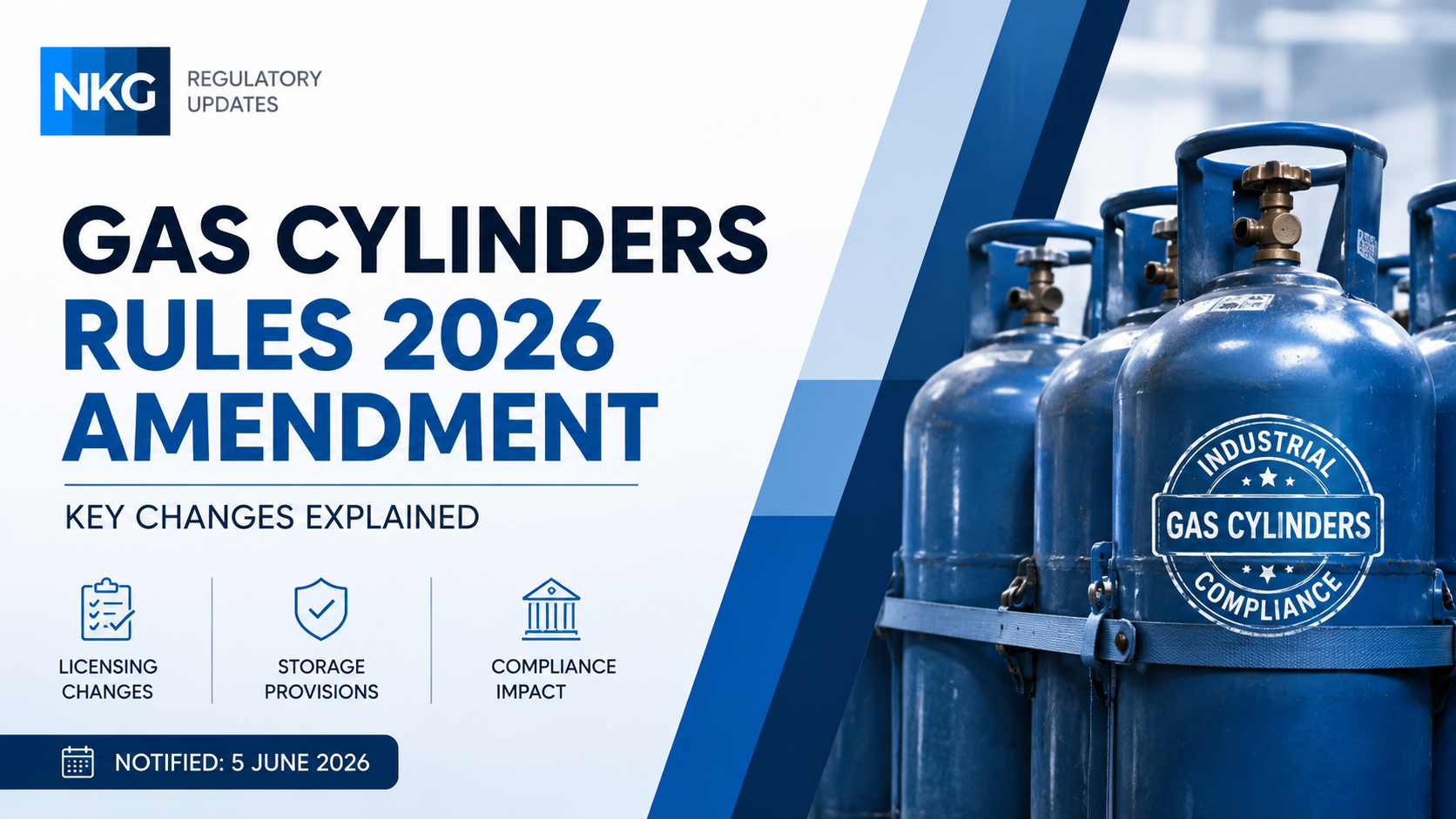
Gas Cylinders Rules 2026 Amendment introduces targeted changes to the Gas Cylinders Rules, 2016, through the Gas Cylinders (Second Amendment) Rules, 2026, notified by the Government of India under G.S.R. 447(E) dated 5 June 2026. The amendment omits Rule 48, revises certain licence application documentation requirements, and introduces a new provision permitting higher stacking and reduced gangway space for industrial gas cylinders under specified conditions.
While the amendment is relatively focused in scope, businesses involved in manufacturing, storing, importing, or handling industrial gas cylinders should understand how these changes fit within the existing regulatory framework. The notification does not replace the Gas Cylinders Rules, 2016, but modifies selected provisions that affect licensing and storage practices.
What is the Gas Cylinders Rules 2026 Amendment?
The Gas Cylinders Rules 2026 Amendment refers to the Gas Cylinders (Second Amendment) Rules, 2026, notified by the Department for Promotion of Industry and Internal Trade (DPIIT) on 5 June 2026. The amendment updates specific provisions of the Gas Cylinders Rules, 2016 by omitting Rule 48, removing one documentation requirement from Form C, and inserting a new Condition 8A in Form F relating to industrial gas cylinder storage.
What Changed Under the Gas Cylinders Rules 2026 Amendment?
The notification introduces three specific amendments to the existing Gas Cylinders Rules, 2016.
1. Rule 48 Has Been Omitted
The amendment formally omits Rule 48 from the Gas Cylinders Rules, 2016.
The notification does not substitute Rule 48 with a new provision or explain the rationale behind its omission. It simply removes the rule from the regulatory framework. Businesses should therefore refer to the updated version of the Gas Cylinders Rules, 2016 while assessing compliance obligations.
2. Form C Documentation Has Been Revised
The amendment also modifies Form C, which relates to licence applications.
Specifically, Item (vi) under the list of documents required to accompany certain licence applications has been omitted.
No new documentation has been introduced in place of the deleted requirement, meaning applicants should follow the revised documentation requirements under the amended Rules.
3. New Provision for Industrial Gas Cylinder Storage
The most significant operational update under the Gas Cylinders Rules 2026 Amendment is the insertion of Condition 8A in Form F.
Under this provision, the licensing authority may permit:
- Higher stacking of industrial gas cylinders.
- Reduced gangway space within licensed premises.
However, this flexibility is subject to specific conditions.
Industrial gas cylinders must be packed in certified structured packaging, such as racks or cages, supported by adequate straps, clips, or interlocking systems that maintain the integrity of the cylinders and their fittings. Additionally, loading and unloading procedures must comply with applicable national or international codes.
The amendment, therefore, introduces a conditional operational flexibility rather than a general relaxation of storage requirements.
Scope of Applicability
| Category | Status | Notification Position |
|---|---|---|
| Gas Cylinders Rules, 2016 | Amended | Yes |
| Rule 48 | Omitted | Yes |
| Form C | Documentation revised | Yes |
| Form F | New Condition 8A inserted | Yes |
| Industrial Gas Cylinders | Covered under Condition 8A | Yes |
| Certified Structured Packaging | Required for higher stacking permission | Yes |
| Domestic LPG Cylinders | Not specifically addressed | Not stated |
| Medical Gas Cylinders | Not specifically addressed | Not stated |
| BIS Certification Requirements | No change stated | Not covered |
| Quality Control Orders (QCOs) | No change stated | Not covered |
What This Means for Businesses
Manufacturers
Manufacturers operating industrial gas cylinder filling plants or storage facilities should review existing storage layouts and determine whether certified structured packaging systems are already in place.
Where businesses intend to make use of higher stacking arrangements or reduced gangway space, the amended provision indicates that approval remains subject to the licensing authority and compliance with the prescribed conditions.
Importers
Importers storing industrial gas cylinders in licensed warehouses should note that the amendment relates to storage practices rather than product approvals or import eligibility.
Businesses should review warehouse infrastructure and handling procedures where industrial gas cylinders are stored under applicable licence conditions.
Compliance Teams
Compliance managers should evaluate:
- Existing licence conditions.
- Storage infrastructure.
- Structured packaging certifications.
- Loading and unloading procedures.
- Compliance with recognised national or international codes.
The amendment may require updates to internal compliance documentation where storage practices are affected.
What This Does NOT Mean
The Gas Cylinders Rules 2026 Amendment should not be interpreted more broadly than the notification itself.
This amendment does not:
- Introduce a new certification scheme.
- Modify BIS certification requirements.
- Amend any Quality Control Order (QCO).
- Change product applicability.
- Create new licence categories.
- Automatically permit higher stacking for all facilities.
- Remove existing safety obligations under the Gas Cylinders Rules, 2016.
The flexibility introduced under Condition 8A applies only where the specified conditions relating to certified structured packaging and compliant handling procedures are satisfied.
Key Takeaways
- The Government notified the Gas Cylinders (Second Amendment) Rules, 2026 on 5 June 2026.
- Rule 48 has been omitted from the Gas Cylinders Rules, 2016.
- Form C has been revised by removing one documentation requirement.
- New Condition 8A permits higher stacking and reduced gangway space for industrial gas cylinders, provided certain conditions are met.
- The amendment does not modify BIS certification requirements or Quality Control Orders.
- Businesses should review their storage practices for handling industrial gas cylinders.
Frequently Asked Questions
1. What is the Gas Cylinders Rules 2026 Amendment?
The Gas Cylinders Rules 2026 Amendment refers to the Gas Cylinders (Second Amendment) Rules, 2026, notified through G.S.R. 447(E), introducing targeted amendments to the Gas Cylinders Rules, 2016.
2. Has Rule 48 been removed?
Yes. The amendment omits Rule 48 from the Gas Cylinders Rules, 2016.
3. What changes have been made to Form C?
Item (vi) under the list of required documents for specified licence applications has been omitted.
4. What is Condition 8A?
Condition 8A permits licensing authorities to allow higher stacking and reduced gangway space for industrial gas cylinders where certified structured packaging and compliant handling procedures are used.
5. Does this amendment change BIS certification requirements?
The notification does not amend BIS certification requirements.
6. Does the amendment affect Quality Control Orders?
No. The notification does not introduce or amend any Quality Control Order.
Official References
- Official Gazette Notification (Gas Cylinders (Second Amendment) Rules, 2026): https://www.bis.gov.in/wp-content/uploads/2026/06/Gas-Cylinder-Second-Amendment-Rules-05062026.pdf
- Bureau of Indian Standards (BIS): https://www.bis.gov.in/
- Department for Promotion of Industry and Internal Trade (DPIIT): https://dpiit.gov.in/
How NKG Advisory Can Help
Regulatory amendments often require businesses to determine whether operational processes, documentation, or licence conditions need to be reviewed. NKG Advisory assists manufacturers, importers, and compliance teams in understanding regulatory changes, assessing their applicability, and implementing practical compliance measures aligned with the latest government notifications.
For guidance on BIS registration, certification procedures, or factory audit preparation, contact NKG Advisory at www.nkgabc.com or write to navraj@nkgabc.com.