
Introduction
A recent order issued by the Central Drugs Standard Control Organisation (CDSCO) has brought regulatory attention toward formulation scrutiny in imported skincare products.
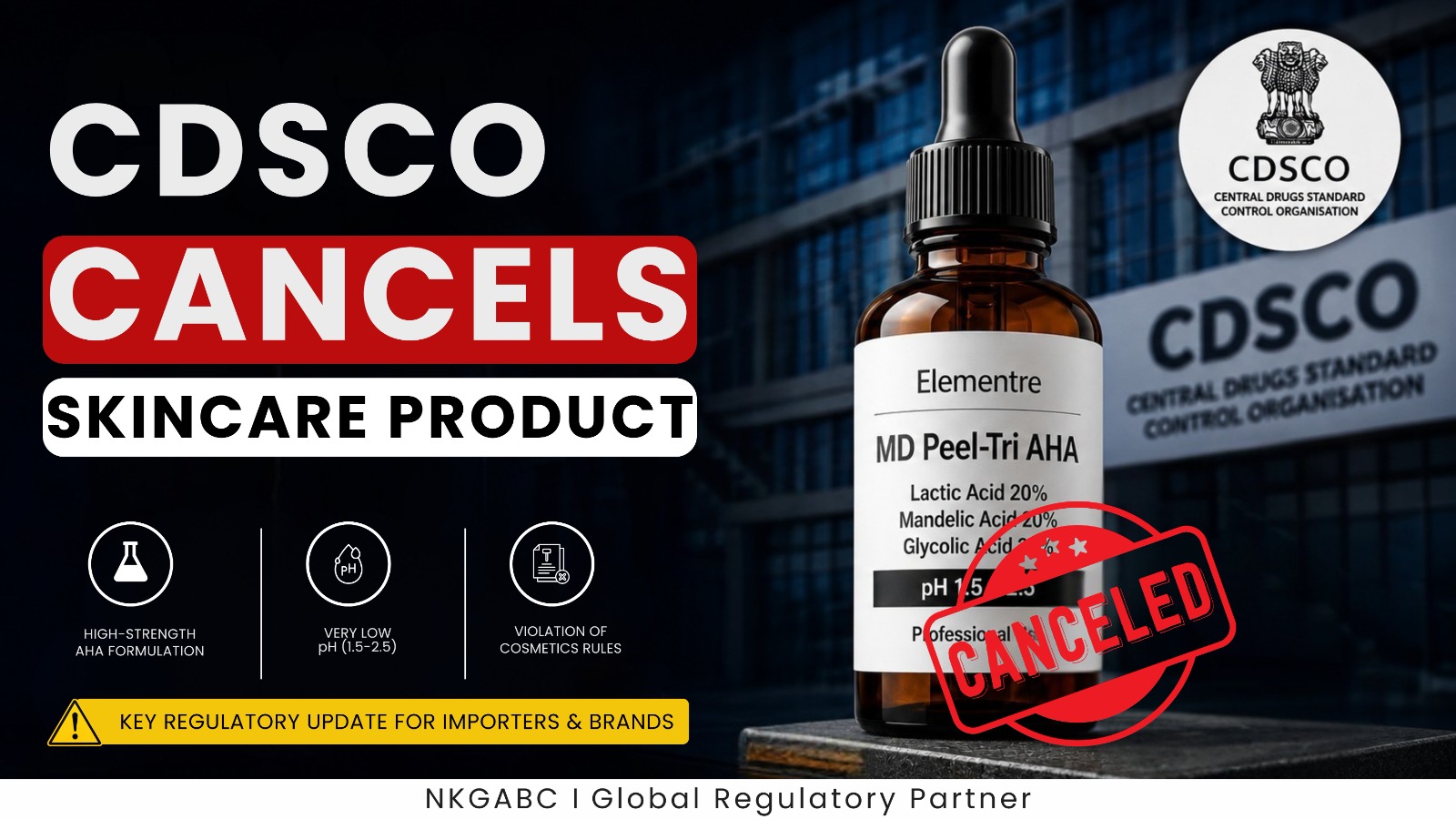
The authority cancelled the registration of an imported cosmetic product, “Elementre – MD Peel-Tri AHA”, after reviewing:
- ingredient concentration,
- low pH profile,
- and product labelling claims.
While the order applies to a specific product, it reflects a broader compliance trend that cosmetic importers and skincare brands should closely monitor.
Regulatory evaluation is increasingly extending beyond documentation alone and into how formulations, safety positioning, and cosmetic claims are presented under the Cosmetics Rules, 2020.
What Triggered the CDSCO Cosmetic Product Cancellation India Order?
According to the order, the imported cosmetic product contained:
- Lactic Acid – 20%
- Mandelic Acid – 20%
- Glycolic Acid – 20%
This resulted in a combined Alpha Hydroxy Acid (AHA) concentration of 60%.
The order further noted that the formulation:
- exceeded 30% of total mono-AHA equivalents,
- and declared a pH range between 1.5 and 2.5 for professional use.
CDSCO observed that the pH profile was “very low”.
The authority also examined the product label claim referring to “patient tolerance”.
Following the review, CDSCO concluded that the product violated:
- Rule 36 of the Cosmetics Rules, 2020
- Rule 39(1) of the Cosmetics Rules, 2020
The registration certificate for the product was subsequently cancelled.
Why This Order Matters Beyond One Product
At a practical level, this order reflects how CDSCO may evaluate:
- formulation strength,
- ingredient concentration,
- product representation,
- and cosmetic safety positioning
during registration assessment.
This is particularly relevant for:
- chemical peels,
- exfoliation systems,
- active-acid skincare products,
- and professional-use cosmetic formulations.
Orders like these often become important regulatory reference points for future scrutiny involving similar categories.
For importers dealing with high-strength skincare products, this is the kind of enforcement trend worth evaluating early rather than after registration queries arise.
What This Does NOT Mean
The order should not be interpreted as:
- a blanket restriction on AHA-based cosmetics,
- a prohibition on professional-use skincare products,
- or a general ban on chemical peels in India.
The cancellation is product-specific and based on CDSCO’s evaluation of:
- ingredient profile,
- pH characteristics,
- and labelling representation under the Cosmetics Rules, 2020.
However, the order clearly indicates increasing attention toward:
- high-strength formulations,
- low pH products,
- and cosmetic labelling compliance with India requirements.
Cosmetics Rules 2020: Rule 36 and Rule 39 Explained
Rule 36 of the Cosmetics Rules, 2020 states that cosmetic products should not contain claims that are false or misleading to users.
Rule 39(1) requires imported or manufactured cosmetics to comply with prescribed quality and safety standards.
From a compliance standpoint, these provisions allow CDSCO to examine:
- formulation safety,
- product claims,
- labelling language,
- ingredient disclosures,
- and overall cosmetic positioning.
For imported skincare brands, this becomes increasingly important where products are marketed as:
- professional-use,
- clinical-grade,
- or performance-oriented cosmetic solutions.
Professional-use positioning alone may not reduce regulatory scrutiny under the Indian cosmetic framework.
Cosmetic Labelling Compliance India Is Receiving Greater Attention
One of the strongest signals from this order is the authority’s focus on labelling and representation.
Terms associated with:
- tolerance,
- treatment positioning,
- clinical performance,
- or advanced skin outcomes
may attract closer regulatory evaluation if they appear misleading within the cosmetic category.
In several cases, regulatory concern may arise not from a single ingredient alone, but from the combined interpretation of:
- formulation profile,
- concentration strength,
- product claims,
- and intended use representation.
This is where cosmetic labelling compliance India becomes operationally important for importers and skincare brands.
Industry Impact
This CDSCO cosmetic product cancellation India order is likely to be closely watched by:
- cosmetic importers,
- skincare brands,
- formulation consultants,
- regulatory affairs professionals,
- and aesthetic product distributors.
Particularly within categories involving:
- glycolic acid products,
- lactic acid formulations,
- mandelic acid peels,
- resurfacing products,
- and professional exfoliation systems.
The order reinforces the importance of:
- pre-submission formulation review,
- regulatory assessment of claims,
- and alignment between product positioning and cosmetic compliance expectations.
What Importers Should Review Before Registration
Before applying for cosmetic import registration in India, brands should carefully assess:
- ingredient concentrations,
- formulation profile,
- pH characteristics,
- warning statements,
- labelling language,
- intended cosmetic use,
- and packaging representation.
Early compliance assessment can significantly reduce the risk of:
- regulatory objections,
- show cause notices,
- or registration enforcement actions.
Official Reference
Order issued by: Central Drugs Standard Control Organisation (CDSCO) (Click to View)
Directorate General of Health Services
Ministry of Health & Family Welfare
Dated: 11 May 2026
Quick Takeaway
The CDSCO cosmetic product cancellation India order reflects increasing regulatory scrutiny toward:
- high-strength skincare formulations,
- low pH cosmetic products,
- and labelling representation under the Cosmetics Rules 2020.
While the cancellation applies to a specific product, the broader regulatory signal is clear.
Formulation assessment, safety positioning, and cosmetic labelling compliance are becoming increasingly important during cosmetic registration review in India.
For guidance on cosmetic import registration, cosmetic labelling compliance India requirements, or regulatory assessment under Cosmetics Rules 2020, contact NKG Advisory at www.nkgabc.com or write to navraj@nkgabc.com.