Introduction
Regulatory updates in product compliance often refine scope or timelines. Occasionally, they draw a clear line on mandatory certification.
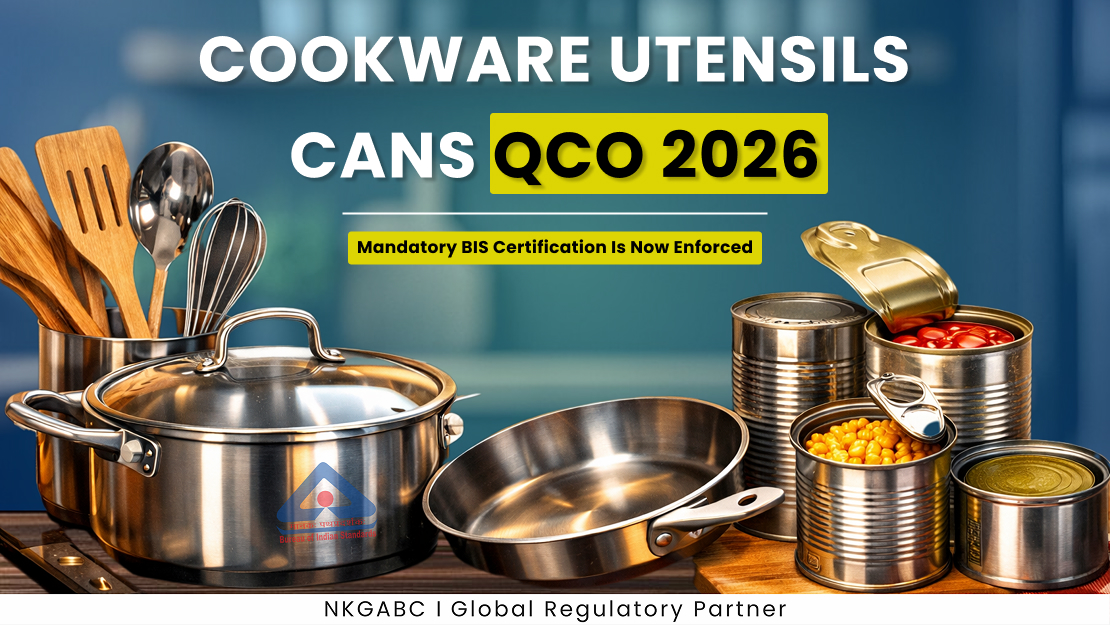
The Cookware Utensils Cans QCO 2026 marks that shift.
The Government, in consultation with the Bureau of Indian Standards, has issued the Cookware, Utensils and Cans for Foods and Beverages (Quality Control) Order, 2026. The notification establishes mandatory BIS certification requirements for specific categories of cookware and food-contact products.
The order comes into force upon its publication in the official Gazette.
What Changes Under the Cookware Utensils Cans QCO 2026
What changes here is not the framework, but the enforcement of mandatory certification for defined product categories.
Under this QCO:
- Products must conform to the applicable Indian Standards
- Products must carry the BIS Standard Mark
- Certification must be obtained under Scheme-I (licensing route)
This is a direct compliance requirement. It introduces a mandatory certification obligation, not an optional pathway.
Products Covered Under BIS Certification
The order applies to specific categories linked to food contact and household usage.
Covered products include:
- Stainless steel utensils → IS 14756:2024
- Stainless steel sinks (domestic use) → IS 13983:1994
- Three-piece round open top metal cans (food & beverage) → IS 18427:2024
These standards will apply in their latest versions, including amendments notified by BIS.
From a compliance standpoint, this brings utensils, sinks, and food cans into a regulated certification environment.
Cookware QCO India Implementation Date (BIS Timeline)
The cookware QCO India implementation date BIS varies by enterprise category:
- General (other than MSMEs) → 1 October 2025
- Small enterprises → 1 January 2026
- Micro enterprises → 1 April 2026
This staggered approach provides a transition window, but does not dilute the requirement.
What This Order Does NOT Apply To
Clarity on exclusions is essential for correct interpretation.
The order does not apply to:
- Products manufactured for export
- Existing stock manufactured or imported before implementation (allowed for 6 months with declaration)
- Imported goods already filled with contents (solid, liquid, or gas)
- Up to 200 units per year imported for R&D purposes (non-commercial use)
These exemptions define operational flexibility but do not affect the core certification requirement.
Understanding BIS Certification for Stainless Steel Utensils in India
From a regulatory perspective, bis certification for stainless steel utensils india now becomes mandatory within this defined scope.
Unlike framework-level updates, this QCO:
- identifies specific product categories
- links them to defined Indian Standards
- enforces certification through BIS licensing
This places manufacturers and importers directly within the BIS conformity assessment system.
Industry Impact: Who Needs to Act
The notification has direct implications for:
Manufacturers
Domestic manufacturers of cookware, utensils, sinks, and food cans must:
- align products with applicable standards
- obtain BIS certification before the applicable date
Importers
Importers must ensure:
- products are BIS certified prior to import
- supply chains are aligned with certification timelines
Compliance and Quality Teams
Internal teams must:
- map product categories to applicable standards
- initiate certification processes early
- monitor implementation deadlines
Practical Compliance Steps for Businesses
From an execution standpoint, businesses should begin with:
- identifying whether their products fall under the notified categories
- mapping applicable Indian Standards to each product
- initiating BIS certification timelines aligned with implementation dates
- coordinating with testing labs and certification bodies early
Early preparation reduces the risk of supply disruption once enforcement begins.
What to Watch Next
At a structural level, this QCO signals continued expansion of product-specific mandatory certification in India.
Businesses should monitor:
- additional QCOs covering adjacent product categories
- updates to Indian Standards
- enforcement timelines and inspection practices
The direction is consistent: greater standardization and tighter regulatory control over consumer-facing products.
Official Reference
The order has been published in the official Gazette by the Government of India.
Quick Takeaway
The cookware utensils cans QCO 2026 mandates BIS certification for selected cookware and food-contact products.
It introduces:
- defined product scope
- mandatory certification under Scheme-I
- clear implementation timelines
The requirement is not conditional. It is time-bound and enforceable. For manufacturers and importers, the focus now shifts from awareness to execution.
Businesses working with Indian Standards or BIS-regulated products should monitor future regulatory notifications that may reference Scheme-II.
For guidance on BIS registration, certification procedures, or factory audit preparation, you may contact NKG Advisory at www.nkgabc.com or write to navraj@nkgabc.com.