Introduction
A new compliance layer has been introduced for electrical products in India.
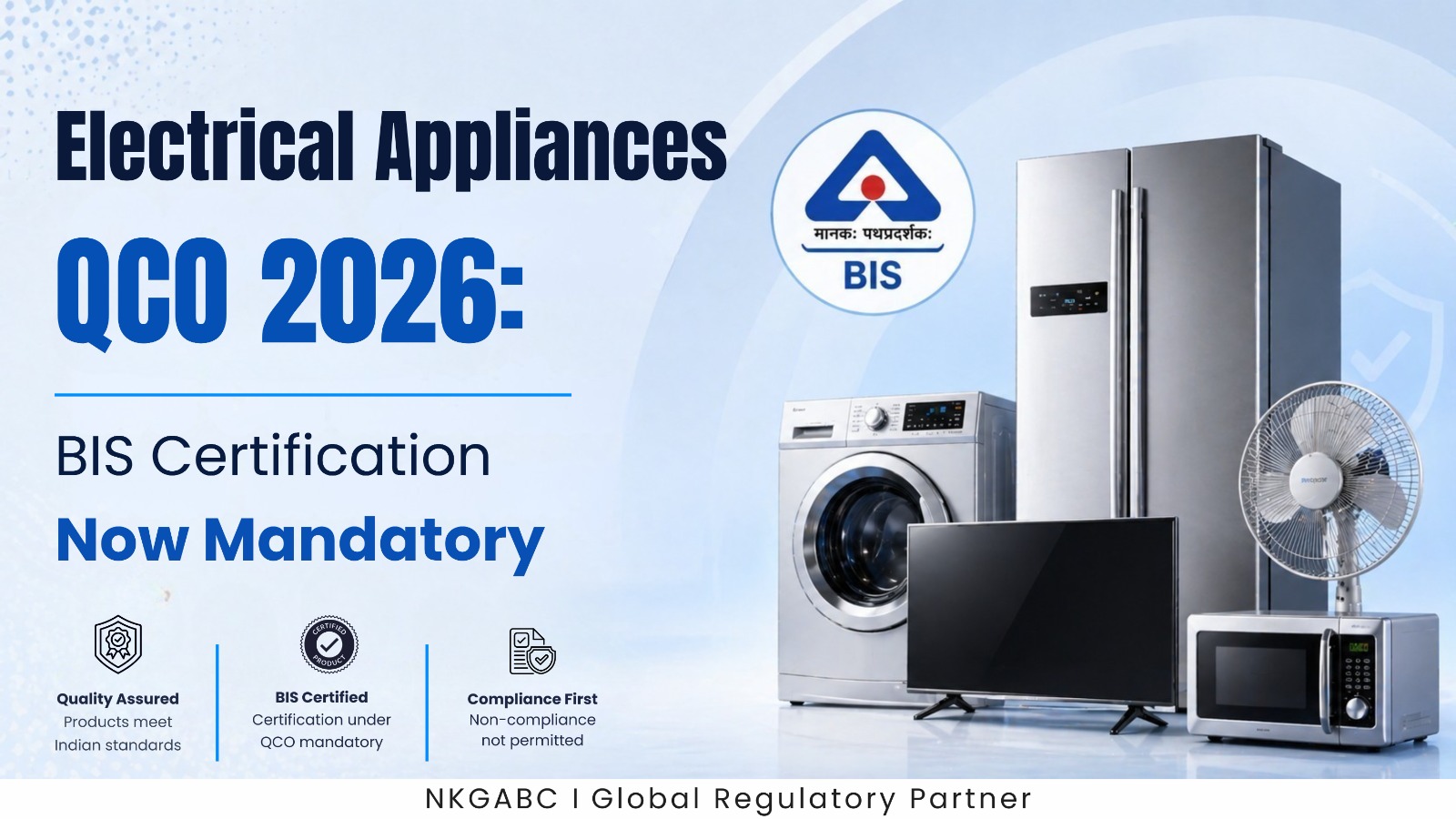
The electrical appliances QCO 2026 has been issued by the Government to regulate safety standards across a wide range of electrical appliances used in household and commercial environments.
This order replaces the earlier 2025 version and expands the scope of mandatory certification significantly. From a regulatory standpoint, this is not a routine update. It signals a broader push toward structured electrical appliances BIS compliance India.
What Changed
At a structural level, the electrical appliances QCO 2026 introduces three key changes.
First, the scope of products has expanded. The order now applies to a wide range of electrical appliances across household, commercial, and similar applications.
Second, compliance is linked to a defined safety benchmark. All applicable products must conform to the IS 302 Part 1 2024 standard, aligned with IEC 60335-1.
Third, certification is now mandatory. BIS certification for electrical appliances India is required before products can be sold, imported, or distributed in the market.
This means manufacturers and importers must obtain a BIS license under Scheme-I and affix the Standard Mark.
What This Does NOT Mean
The electrical appliances QCO 2026 does not change everything.
It does not come into force immediately. The implementation begins from October 2026.
It does not override other Quality Control Orders already applicable to specific product categories.
It also does not introduce self-declaration routes. Compliance continues to require BIS certification under Scheme-I.
Understanding these boundaries is critical for accurate compliance planning.
Technical Scope of the Regulation
The applicability of the electrical appliances QCO 2026 is defined through usage and electrical parameters.
The order applies to:
- Electrical appliances intended for household, commercial, or similar use
- Equipment with rated voltage:
- Up to 250V for single-phase appliances
- Up to 480V for other appliances, including DC and battery-operated products
This framework ensures that both traditional and modern electrical appliances fall within scope.
From a compliance standpoint, the household electrical appliances QCO India is not limited to domestic usage but extends across multiple application environments.
Product Coverage
The regulation covers a large number of product categories.
The official notification lists around 90 types of electrical appliances.
These include:
- Kitchen appliances such as ovens, cooktops, and food processors
- Cleaning equipment like vacuum cleaners and floor machines
- Personal care devices, including shavers and beauty appliances
- Heating equipment such as boilers and warming devices
- Commercial appliances like grills, dishwashers, and kitchen machines
- Battery-operated appliances across multiple categories
The breadth of coverage makes this one of the most extensive electrical QCOs introduced so far.
Implementation Timeline
The electrical appliances QCO 2026 follows a phased implementation.
- General implementation: 1 October 2026
- Small enterprises: 1 January 2027
- Micro enterprises: 1 April 2027
Additionally, products manufactured or imported before the implementation date can be sold for up to six months, subject to declaration conditions.
This provides a limited transition window for businesses to align with the new requirements.
Compliance Requirements
To meet BIS certification for electrical appliances India, businesses must ensure:
- Conformity with the IS 302 Part 1 2024 standard
- Certification under BIS Scheme-I
- Testing through BIS-recognized laboratories
- Affixing the Standard Mark before sale
- Maintaining proper compliance documentation
Failure to comply can result in penalties under the BIS Act, 2016.
Industry Impact
The electrical appliances QCO 2026 affects multiple stakeholders.
Manufacturers must reassess product design, testing, and certification timelines.
Importers need to ensure that products entering India meet BIS requirements before market entry.
Compliance teams will have to map product portfolios against the expanded coverage and initiate certification planning early.
At a broader level, this strengthens regulatory control over electrical appliances BIS compliance India.
What to Watch Next
The real impact of the electrical appliances QCO 2026 will depend on implementation.
Businesses should monitor:
- BIS enforcement approach
- Clarifications on product classification
- Overlaps with existing QCOs
- Certification timelines for high-demand categories
These factors will determine how compliance requirements evolve in practice.
Official Reference
Safety of Household, Commercial, and Similar Electrical Appliances (QCO), 2026 Gazette Notification dated 6 April 2026 (Tap to view)
Quick Takeaway
The electrical appliances QCO 2026 expands mandatory BIS certification across a wide range of electrical appliances.
It introduces defined safety standards, broader product coverage, and phased timelines.
For businesses, the requirement is clear: If your product falls within scope, BIS certification is mandatory before it reaches the market.
For guidance on BIS registration, certification procedures, or factory audit preparation, contact NKG Advisory at www.nkgabc.com or write to navraj@nkgabc.com.