BIS certification for animal feed is entering a new compliance phase in India—and the biggest detail manufacturers should notice is not just what is becoming mandatory, but when.
The Government has issued the Animal Feeds and Feed Ingredients (Quality Control) Order, 2026 under S.O. 5576(E). The Order was dated 7 October 2026 and published in the Gazette of India on 12 October 2026.
It brings three specified animal-feed products under mandatory BIS conformity and the Standard Mark under Scheme-I.
But there is a twist: not every business gets the same deadline.
BIS Certification for Animal Feed: Three Products Come Into Scope
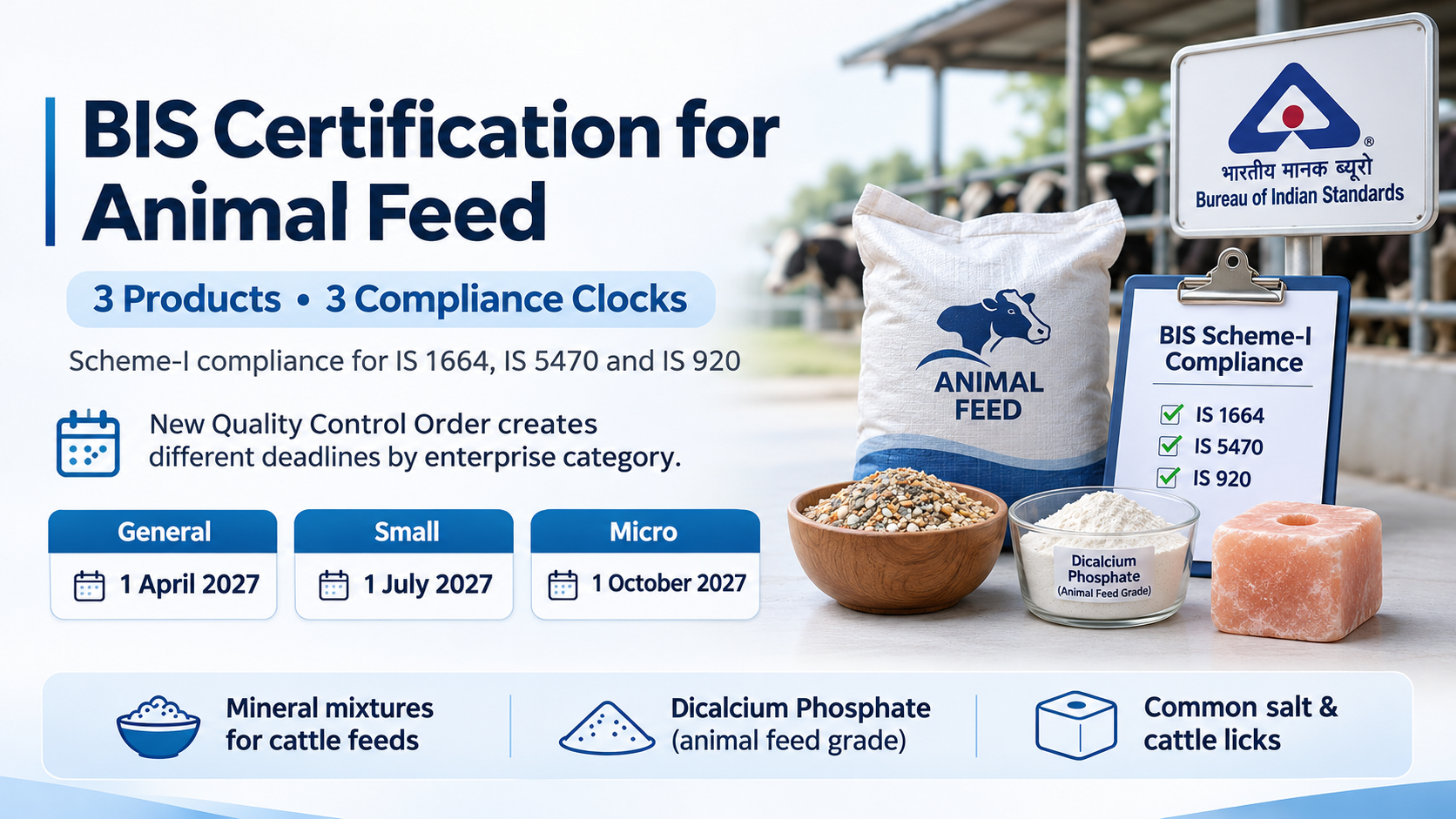
The new QCO covers:
| Product | Indian Standard |
| Mineral mixtures for supplementing cattle feeds | IS 1664 |
| Dicalcium Phosphate, animal feed grade | IS 5470 |
| Common salt and cattle licks for animal consumption | IS 920 |
Under the Order, these products must conform to the applicable Indian Standard and bear the BIS Standard Mark under a valid licence issued under Scheme-I of Schedule-II of the BIS Conformity Assessment Regulations, 2018.
The official notification can be located through the Government’s eGazette portal. Official eGazette portal
The Real Story: Three Businesses, Three Compliance Clocks
This is where the QCO becomes especially important.
For enterprises other than micro and small enterprises, mandatory compliance begins on:
1 April 2027
For small enterprises, the implementation date is:
1 July 2027
For micro enterprises, the deadline moves to:
1 October 2027
So the same product may face three different enforcement dates depending on the enterprise category.
That makes BIS certification for animal feed a planning issue—not simply an application exercise.
A manufacturer should first confirm its enterprise status, applicable product standard and certification readiness before building production and sales timelines around 2027.
Export Products Get an Important Exemption
The Order specifically states that it does not apply to goods or articles meant for export.
That distinction matters for manufacturers producing both for India and international markets.
Domestic-market inventory may need to meet the QCO requirements once the applicable implementation date arrives, while goods genuinely meant for export fall outside this Order.
Companies handling both streams should keep production, documentation and inventory controls clearly separated.
BIS Is Both the Certification and Enforcement Authority
The notification names the Bureau of Indian Standards as the certification and enforcement authority for the listed goods.
It also states that violations are punishable under the BIS Act, 2016.
This means businesses should not treat the deadline as merely advisory.
Once the relevant implementation date applies, selling covered products without the required conformity can create regulatory exposure.
For a broader explanation of how Scheme-I works, businesses can read NKG’s internal guide on BIS Certification Schemes in India and NKG’s BIS Scheme-I certification services.
One More Detail Manufacturers Should Not Miss
The QCO says the latest version of the applicable Indian Standards, including amendments notified by BIS from time to time, will apply.
That means businesses should not rely indefinitely on an old copy of IS 1664, IS 5470 or IS 920.
Before testing or certification, confirm the current standard version and any applicable amendments.
What Should Animal-Feed Businesses Do Now?
The smartest response is not to wait until March 2027.
Manufacturers should determine whether their products fall within the notified scope, confirm enterprise classification, review the applicable standard, assess in-house testing and manufacturing readiness, and begin the BIS certification for animal feed process with enough time to handle technical gaps.
Think of the new QCO as a countdown:
Product Scope → Standard Review → Enterprise Category → Testing → Scheme-I Licence → Mandatory Compliance Date
The Order is already published.
The deadlines are already visible.
For animal-feed manufacturers, 2027 compliance planning should start now—not when the clock is almost at zero.