Introduction
The Government has notified the Legal Metrology (Packaged Commodities) Amendment Rules, 2026, introducing a structural compliance shift for online sellers. The Legal Metrology Amendment 2026 for e-commerce inserts sub-rule 10A under Rule 6 of the Legal Metrology (Packaged Commodities) Rules, 2011.
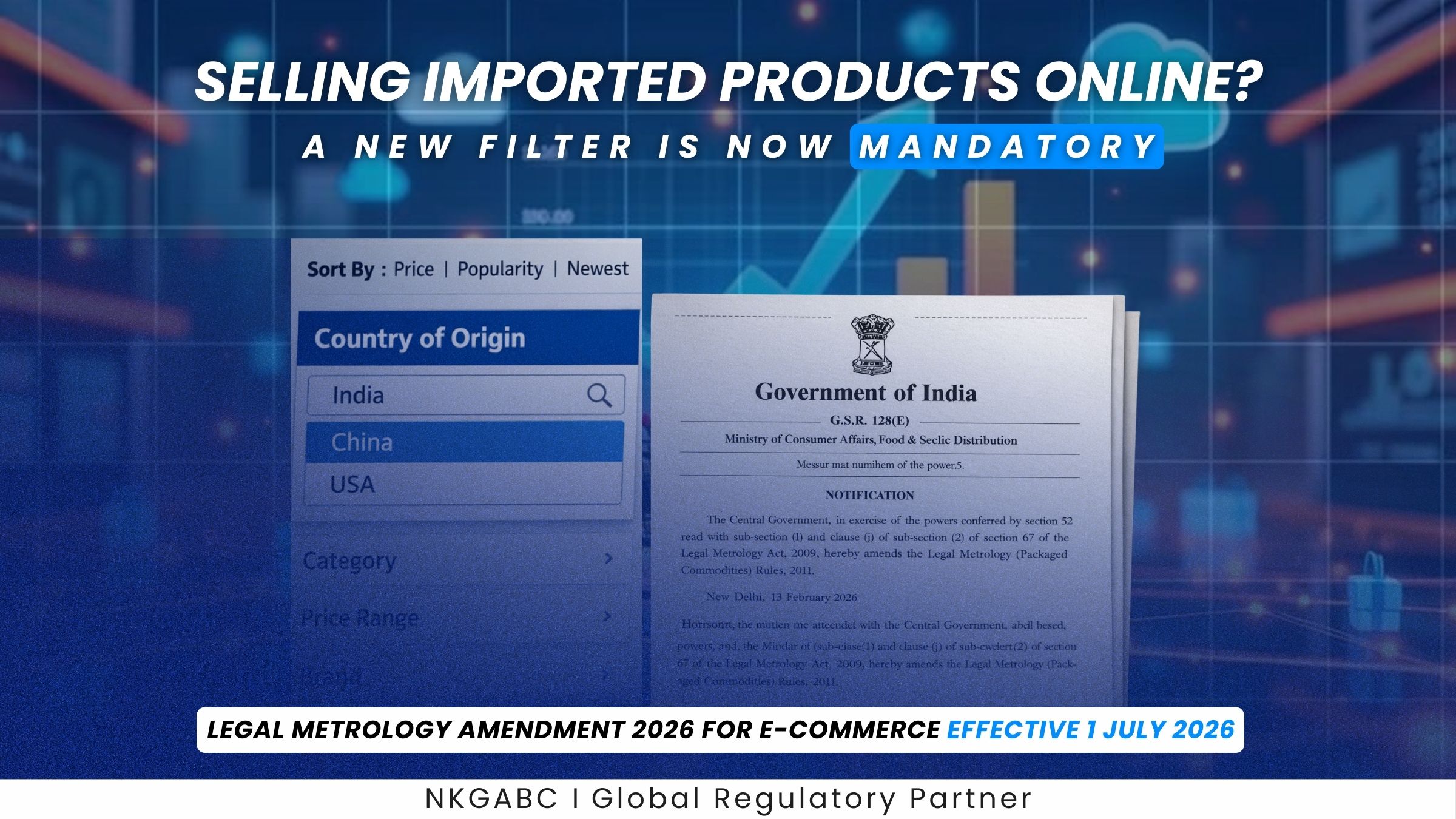
Effective 1 July 2026, every e-commerce entity selling imported products must provide product listings in a searchable and sortable filter specifying the country of origin.
This is not a new labeling requirement. It is a platform architecture requirement.
What the Amendment Actually Changes
The amendment introduces a specific legal metrology country of origin filter requirement. The language of sub-rule 10A is direct. Every e-commerce entity selling imported products must provide product listings of such imported products in a searchable and sortable filter specifying the country of origin.
Country of origin declaration for imported packaged commodities already exists under Rule 6. That obligation remains unchanged.
What is new is the mandatory consumer interface functionality:
• The country of origin must be searchable.
• The country of origin must be sortable as a filter.
This moves compliance from packaging and labeling into digital architecture.
Is This Just a New Rule for Imported Products Online in India?
Many businesses may interpret this as a general “new rule for imported products online in India.” That reading is incomplete.
The rule does not introduce a new declaration field. It mandates how the country of origin information must function within product listings.
In other words, disclosure alone is no longer sufficient if it cannot be filtered or sorted.
This means backend taxonomy, product metadata tagging, and frontend filter logic must support country of origin as a structured attribute.
Does This Apply Only to Marketplaces?
One of the most important interpretational questions relates to scope. Businesses frequently ask about legal metrology applicability to D2C websites.
The rule states: “Every e-commerce entity selling imported products…”
The phrase “e-commerce entity” is not limited to marketplaces. It does not exclude brand-owned websites. Therefore, if a D2C brand operates its own online portal and sells imported packaged commodities, it falls within scope.
This applies across categories. Beauty, electronics, fashion, home goods, supplements, FMCG, and other packaged products are not excluded if imported.
The compliance responsibility is tied to the entity operating the online sale platform.
What Businesses Must Now Assess
Companies dealing in imported packaged commodities must examine whether their current systems:
• Capture country of origin as a structured data field
• Allow country of origin to function as a searchable attribute
• Enable consumers to sort products based on country of origin
If a website merely mentions the country of origin within product descriptions without enabling filtering functionality, it will not satisfy the rule once it comes into force.
This creates an operational obligation under the country of origin filter for imported products India, requiring coordination between compliance, technology, and product teams in India
Why This Is a Structural Compliance Shift
Legal Metrology compliance has traditionally focused on packaging declarations, net quantity, manufacturer details, and labeling accuracy. This amendment extends compliance into digital consumer interfaces.
The rule requires structural display architecture changes, not textual disclosure updates.
It affects:
• Product database structures
• Filter panel configurations
• Search indexing logic
• Metadata consistency
This means that legal, IT, and operations functions must align before 1 July 2026.
Regulatory Reference and Legal Position
The amendment was issued under G.S.R. 128(E) dated 13 February 2026. It inserts sub-rule 10A under Rule 6 of the Legal Metrology (Packaged Commodities) Rules, 2011.
For formal interpretation, businesses must refer to the legal metrology packaged commodities amendment 2026 notification and the parent Legal Metrology Act, 2009.
The rule comes into force on 1 July 2026. There is no transitional relaxation mentioned in the notification.
It is important to distinguish:
• The amendment does not introduce a new declaration obligation.
• It introduces a mandatory searchable and sortable filter.
• It applies specifically to imported products governed by the Packaged Commodities Rules.
Official Notification
The amendment was notified vide G.S.R. 128(E) dated 13 February 2026 by the Ministry of Consumer Affairs, Food and Public Distribution.
Businesses may refer to the official notification for the complete legal text of sub-rule 10A under Rule 6 of the Legal Metrology (Packaged Commodities) Rules, 2011.
Practical Risk Areas for D2C Brands
D2C brands often assume that regulatory display rules primarily concern marketplaces. However, the wording of the amendment does not create that limitation.
Common risk scenarios include:
• Shopify or custom-built websites lacking structured country filters
• Imported SKUs without standardized country-of-origin tagging
• Inconsistent metadata across product catalogs
• Filter panels that do not include origin as a selectable attribute
These gaps could result in non-compliance after 1 July 2026.
Timeline and Immediate Action
With enforcement beginning on 1 July 2026, businesses should initiate:
• Internal compliance review
• Technology capability assessment
• Product data mapping
• Filter interface testing
Given the structural nature of the requirement, implementation may require development cycles rather than simple content updates.
Conclusion
The Legal Metrology Amendment 2026 for e-commerce signals a clear regulatory direction: transparency must be built into platform architecture, not just product packaging.
For businesses selling imported packaged commodities online, compliance now extends beyond declaration to functionality. The rule does not target a single category. It applies to all e-commerce entities selling imported products covered under the Packaged Commodities framework.
D2C brands, marketplace operators, and importers must ensure that the country of origin is not only displayed but also searchable and sortable before 1 July 2026.
In compliance, staying informed is the first step to staying prepared. For support on Legal Metrology compliance, e-commerce regulatory advisory, or import-related obligations, reach us at www.nkgabc.com or email navraj@nkgabc.com.
To stay updated with more insights on compliance, certifications, and industry trends, explore our blog page or connect with us on LinkedIn for regular updates.