Introduction
Recent regulatory developments have prompted manufacturers, importers, and compliance teams to reassess how cookware and food-contact packaging products are regulated in India. The Cookware Utensils and Cans QCO 2026 introduces mandatory conformity requirements under the Quality Control Order framework administered by the Bureau of Indian Standards. Understanding what the Order covers, how it applies to specific products, and when compliance becomes mandatory is essential for avoiding disruption across manufacturing, sourcing, and import operations.
Why This Quality Control Order Was Introduced
Cookware, utensils, and food and beverage packaging come into direct contact with consumables. Products in this category are widely used across households, commercial kitchens, and the food and beverage industry, making consistency, material safety, and quality assurance critical. Under India’s regulatory approach, the Quality Control Order mechanism is used to assess whether mandatory conformity with Indian Standards is necessary in the public interest and whether the industry is prepared for enforcement at scale.
The 2026 Order represents a consolidated regulatory position following several years of scope evaluation and refinement.
What Changed Under the QCO Framework
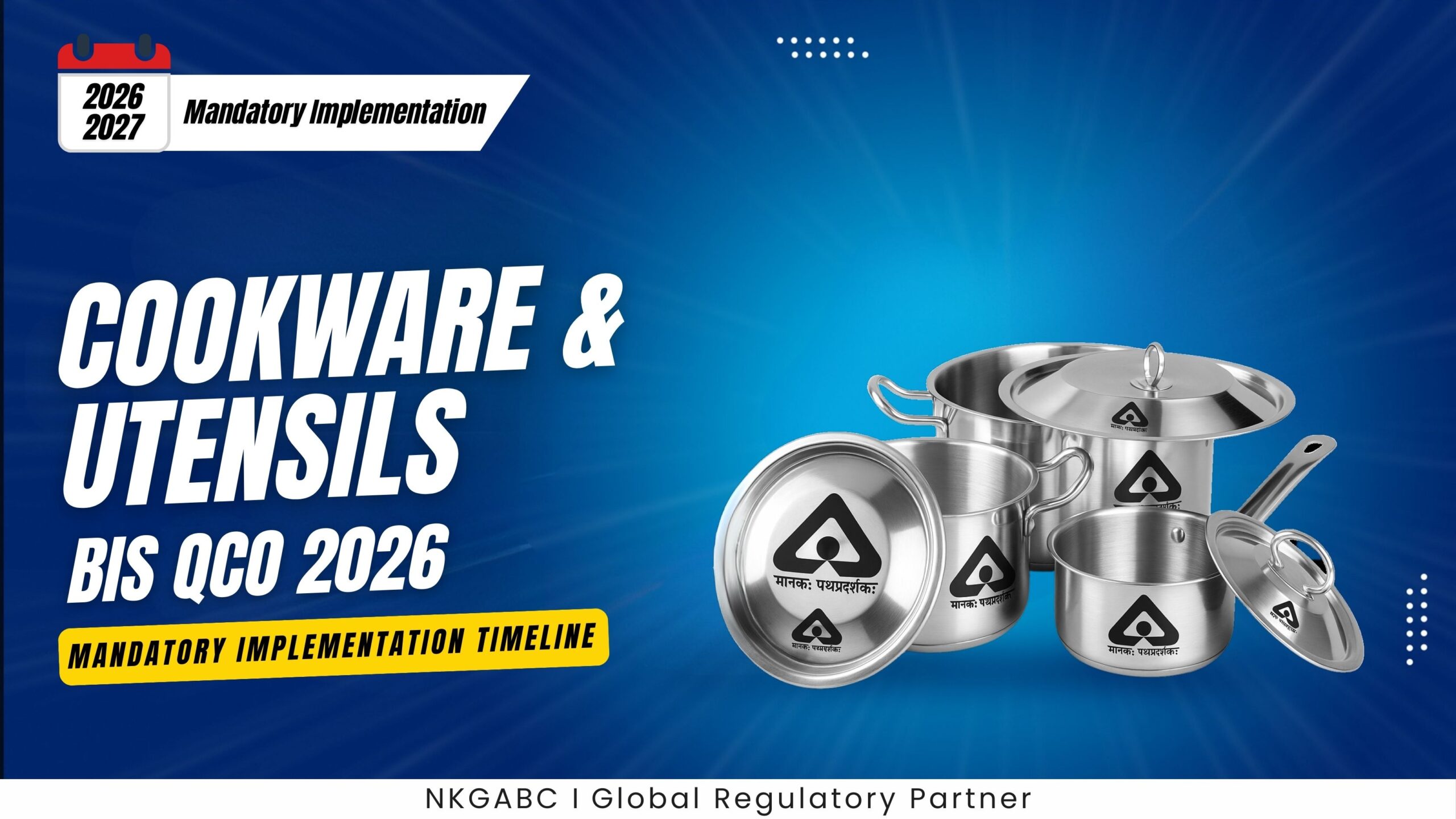
The Cookware Utensils and Cans QCO 2026 mandates the compulsory use of the BIS Standard Mark for notified goods. Products falling within the scope of the listed Indian Standards must conform to the applicable specifications and obtain certification under Scheme I of Schedule II of the Bureau of Indian Standards (Conformity Assessment) Regulations, 2018.
The Order also specifies:
- Staggered implementation timelines,
- Exemptions for exports,
- Provisions for pre-existing stock, and
- Specific relaxations for micro and small enterprises.
Applicable Indian Standards and Product Coverage
The QCO covers two product categories, defined entirely by their corresponding Indian Standards.
| Product Category | Description |
|---|---|
| Cookware, utensils and cans for food and beverages | Wrought aluminium utensils intended for food-contact applications |
| Aluminium cans for beverages | Aluminium cans designed for use with beverages |
Indian Standards referenced
- IS 1660:2024 – Wrought Aluminium Utensils
- IS 14407:2023 – Aluminium cans for beverages
Regulatory Note:
For the purposes of this Order, the latest version of each Indian Standard, including amendments notified by BIS from time to time, applies from the date of such notification.
Mandatory Implementation Dates
The implementation timeline is staggered based on enterprise classification:
- General implementation (other than micro and small enterprises): 1 October 2026
- Small enterprises: 1 January 2027
- Micro enterprises: 1 April 2027
Products manufactured or imported before the applicable implementation date may be sold or offered for sale for up to six months, subject to a declaration certified by a Chartered Accountant and submitted to BIS.
Applicability and Legal Interpretation
A common industry question concerns the cookware BIS QCO applicability India. The correct interpretation is that applicability is standard-driven, not brand-, variant-, or size-driven. If a product falls within the technical scope of the notified Indian Standard, the QCO applies from the relevant implementation date.
Commercial naming, packaging format, or product segmentation does not determine coverage. Technical conformity with the Indian Standard does.
BIS Certification Requirements
Another recurring area of confusion relates to the utensils BIS certification requirements. Under this QCO:
- BIS certification is mandatory for covered products once the applicable implementation date is reached.
- Products must bear the BIS Standard Mark under a valid licence.
- Certification requirements apply equally to domestically manufactured and imported goods, unless a specific exemption is stated.
The Order does not remove or dilute Indian Standards. Instead, it elevates compliance with those standards from a market-driven expectation to a mandatory legal requirement.
Product-Specific Interpretation
Aluminium Utensils
For manufacturers and suppliers of aluminium cookware and aluminium utensils, BIS QCO India reflects applicability through IS 1660:2024. Any wrought aluminium utensil intended for food contact and falling within the scope of this standard must comply with its technical specifications and certification requirements once enforcement begins.
Aluminium Cans for Beverages
For packaging manufacturers and beverage brands, aluminium cans for beverages BIS QCO applies through IS 14407:2023. This standard governs the quality and performance parameters for beverage cans and becomes mandatory under the QCO framework according to the stated timelines.
Impact on Imports and Trade Operations
Imports are explicitly covered under the Order. Goods imported into India that fall within the scope of the notified standards must meet BIS certification requirements once the relevant implementation date applies.
However:
- The QCO does not apply to goods imported already filled with material in solid, liquid, or gaseous form.
- Manufacturers are permitted to import up to two hundred units per year for research and development purposes, subject to strict non-commercial use and record-keeping conditions.
Evolution of the Cookware and Utensils QCO Framework
Understanding the regulatory progression helps explain why the 2026 Order should be treated as a consolidated and enforceable framework.
| Year | Quality Control Order | Gazette Notification | Regulatory Context |
|---|---|---|---|
| 2023 | Cookware and Utensils (Quality Control) Order, 2023 | S.O. 3583(E), 9 Aug 2023 | Initial QCO covering cookware and utensils |
| 2024 | Cookware, Utensils, and Cans for Foods and Beverages (QCO) | S.O. 1365(E), 14 Mar 2024 | Expanded scope to include cans |
| 2024 | Cookware, Utensils, and Cans for Foods and Beverages (QCO) | S.O. 4494(E), 14 Oct 2024 | Supersession and scope refinement |
| 2025 | Cookware, Utensils, and Cans for Foods and Beverages (QCO) | S.O. 3850(E), 22 Aug 2025 | Transition towards standard-led enforcement |
| 2026 | Cookware, Utensils, and Cans for Foods and Beverages (QCO) | S.O. 219(E), 15 Jan 2026 | Current enforceable framework |
Interpretive Note: This progression reflects regulatory consolidation and scope refinement rather than repeated rollback or dilution of quality requirements.
Official Regulatory Reference
The authoritative legal basis for this Order is the Government of India Gazette notification:
Cookware, Utensils, and Cans for Foods and Beverages (Quality Control) Order, 2026
How Industry Should Respond
Manufacturers and importers should:
- Map product portfolios against the scope of IS 1660:2024 and IS 14407:2023
- Assess BIS certification readiness well ahead of the applicable dates
- Align quality systems, test protocols, and documentation with Indian Standards
- Monitor amendments or clarifications issued by BIS from time to time
Early preparation reduces compliance risk and avoids last-minute operational bottlenecks.
Closing Insight from NKG Advisory
At NKG Advisory, we view this QCO as a transition from expectation-based quality to enforceable conformity for cookware and beverage packaging. The Cookware Utensils and Cans QCO 2026 is narrow in the number of standards it covers, but wide in operational impact. Businesses that approach certification as a readiness exercise rather than a last-minute obligation are better positioned to manage enforcement smoothly and maintain continuity across manufacturing and trade.
In compliance, staying informed is the first step to staying prepared. For BIS registration or factory audit support, reach us at www.nkgabc.com or email navraj@nkgabc.com.
To stay updated with more insights on compliance, certifications, and industry trends, explore our blog page or connect with us on LinkedIn for regular updates.