BIS woven packaging sacks can look deceptively similar on a factory floor.
HDPE. PP. Woven construction. Laminated versions. Industrial use.
But choosing the wrong Indian Standard can send a BIS application down the wrong compliance path.
The biggest confusion today sits between IS 11652:2017, IS 16709:2017 and IS 17399:2020.
Two are designed for 50 kg cement packaging.
The third is not a cement sack at all.
Here is how to tell them apart.
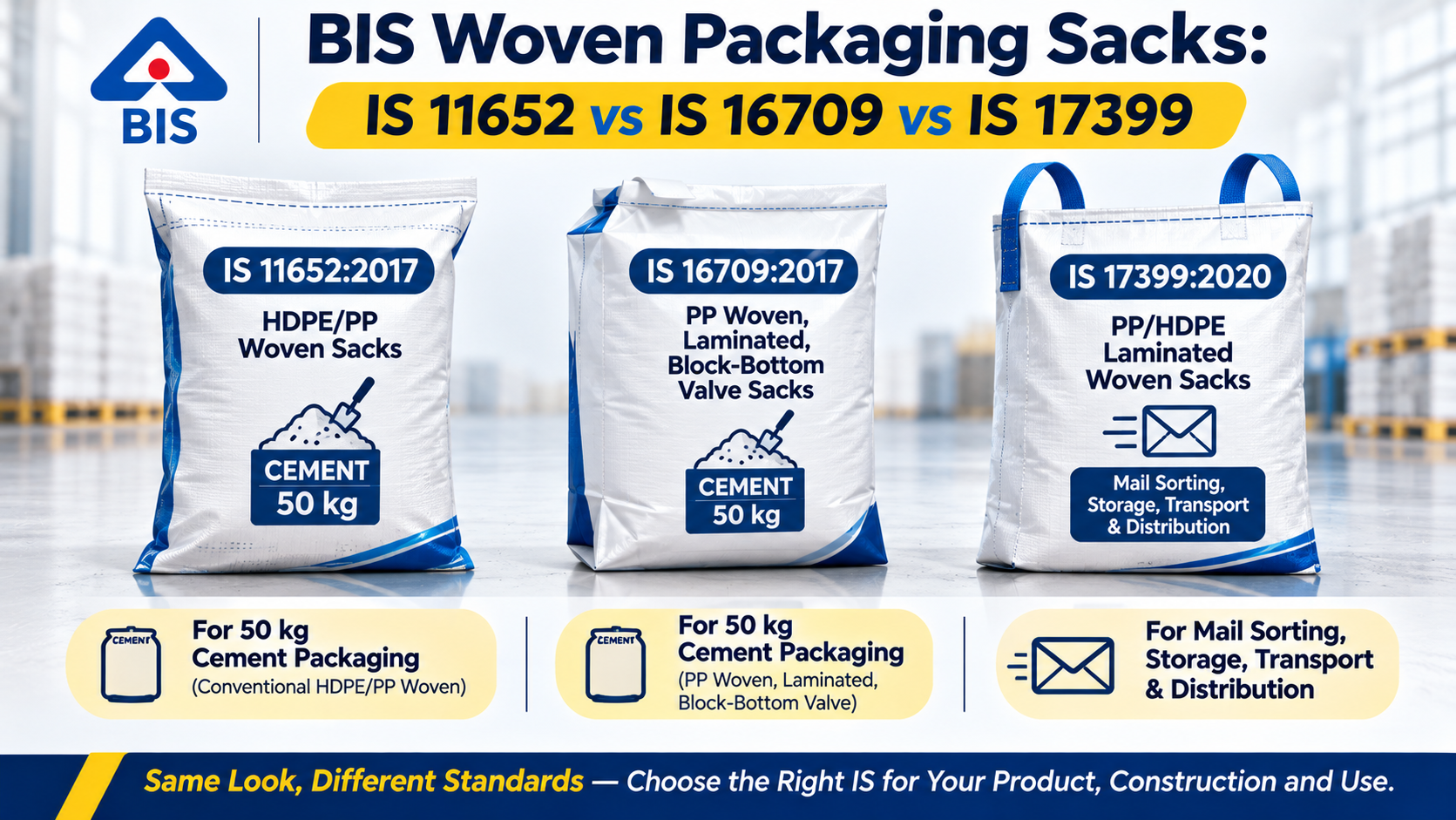
BIS Woven Packaging Sacks: The Three-Standard Comparison
| Standard | Product Covered | Intended Application |
| IS 11652:2017 | HDPE/PP woven sacks | Packaging 50 kg cement |
| IS 16709:2017 | PP woven, laminated, block-bottom valve sacks | Packaging 50 kg cement |
| IS 17399:2020 | PP/HDPE laminated woven sacks | Mail sorting, storage, transport and distribution |
That final row is the distinction businesses must not miss.
IS 17399 is not another cement-bag standard.
It covers laminated woven mail sacks.
IS 11652: The Conventional 50 kg Cement Sack
IS 11652 covers HDPE/PP woven sacks specifically for packaging 50 kg of cement.
BIS has also issued Amendment No. 3 to IS 11652:2017. Its implementation guidance updated requirements including the woven fabric specification and certain dimensional provisions, while also modifying the drop-impact test method.
The BIS circular states that Amendment No. 3 had to be implemented by 7 January 2026.
So manufacturers preparing for mandatory certification should ensure that testing and production controls reflect the amended standard—not an older technical configuration.
The current BIS upcoming-QCO index lists the enforcement date for IS 11652 as 6 January 2027.
IS 16709: Still Cement—But a Different Sack
Here is where product classification gets more interesting.
IS 16709 also covers 50 kg cement packaging, but the product construction is different.
The standard applies to Polypropylene woven, laminated, block-bottom valve sacks.
That means the question is not simply:
“Does this bag carry cement?”
It is:
“What type of cement sack have we actually manufactured?”
A conventional HDPE/PP woven cement sack may point toward IS 11652.
A PP woven, laminated block-bottom valve cement sack may fall under IS 16709.
BIS currently lists 6 November 2026 as the enforcement date for IS 16709.
That date is particularly important because older planning material may show a different timeline. Businesses should work from the current BIS implementation listing rather than an outdated internal workbook.
IS 17399: The One That Does Not Belong in the Cement Bucket
IS 17399 changes the product story completely.
It covers PP/HDPE laminated woven sacks for mail sorting, storage, transport and distribution.
BIS records also show that an All India First Licence under IS 17399:2020 was granted for this exact mail-sack category.
So if your product is designed for postal or mail logistics, IS 17399 may be relevant.
If the product is a 50 kg cement bag, IS 17399 should not be selected simply because the sack is laminated and woven.
The current BIS upcoming-QCO index lists its enforcement date as 6 January 2027.
Why Product Construction Matters More Than the Word “Sack”
This is the real compliance lesson behind BIS woven packaging sacks.
Three products can share similar materials and manufacturing processes while falling under different standards because their construction and intended use differ.
Before filing, manufacturers and importers should identify:
Material → Construction → Lamination → Valve/closure design → Filling capacity → Intended packaged product → Applicable Indian Standard
That product map is far safer than choosing a standard from a generic description.
For broader woven-sack compliance context, NKG already covers HDPE/PP woven sacks under BIS and separately explains BIS requirements for cement packaging. Those articles should support this comparison guide rather than be duplicated here.
Which Standard Covers Your Sack?
Use the simplest decision rule:
50 kg conventional HDPE/PP woven cement sack? → Check IS 11652.
50 kg PP woven laminated block-bottom valve cement sack? → Check IS 16709.
Laminated PP/HDPE sack for mail sorting and logistics? → Check IS 17399.
For BIS woven packaging sacks, the material alone does not decide compliance.
The construction and intended application do.
Getting that distinction right before testing can save manufacturers from the most avoidable BIS mistake of all: certifying the right material against the wrong standard.