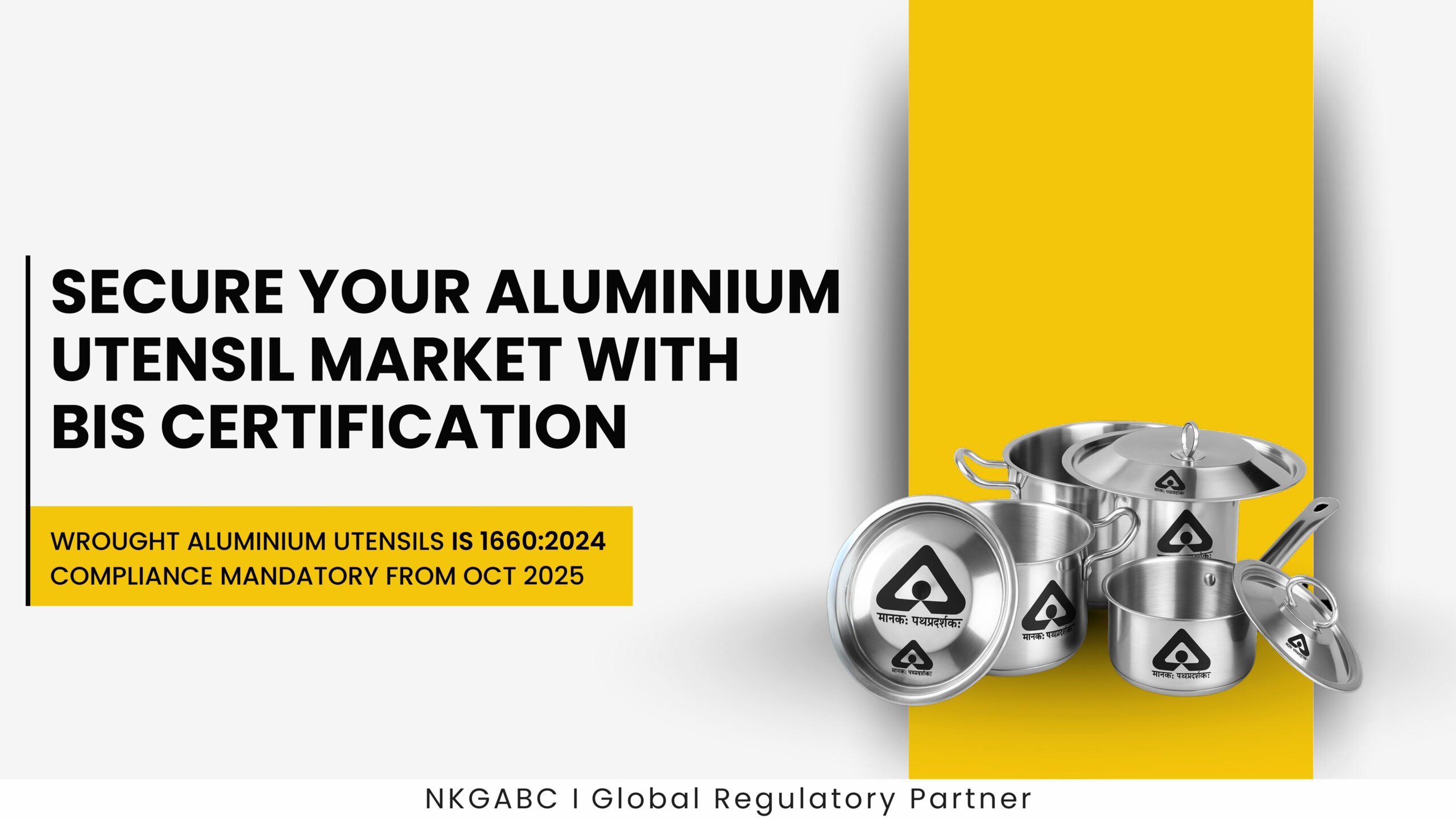
BIS Certification for Wrought Aluminium Utensils IS 1660:2024
The QCO came into effect on August 21, 2025, but compliance for Wrought Aluminium Utensils under IS 1660:2024 is mandatory from October 1, 2025, for general manufacturers, with phased deadlines for MSMEs. Customs authorities will stop shipments that are non-compliant, and retailers will refuse stock that doesn’t carry the ISI mark. That’s why securing BIS certification for Wrought Aluminium Utensils IS 1660 is now a business-critical priority.
What is BIS Certification for Wrought Aluminium Utensils IS 1660?
The Bureau of Indian Standards (BIS) has made compliance with IS 1660:2024 Wrought Aluminium Utensils mandatory under the Cookware, Utensils and Cans for Foods & Beverages (Quality Control) Order, 2025.
A BIS license for Wrought Aluminium Utensils ensures that products meet strict standards of quality, safety, and durability. It also guarantees that every utensil carrying the ISI mark has been manufactured under BIS-approved processes and passed mandatory product testing.
Regulatory Timeline and Extensions
The mandatory certification requirement for cookware and utensils is not new; it has been evolving since 2023. The first Quality Control Order was issued on 9th August 2023, followed by a revised order in March 2024 and further extended in October 2024. Finally, the latest notification, issued on 21st August 2025, supersedes all earlier versions and clearly mandates that compliance with IS 1660:2024 will be compulsory from 1st October 2025 for general manufacturers, with phased deadlines for MSMEs.
Why Mandatory Now (QCO 2025)?
In August 2025, the Government of India notified the Cookware, Utensils, and Cans for Foods & Beverages (Quality Control) Order, 2025.
“As notified under the Cookware, Utensils and Cans for Foods & Beverages (Quality Control) Order, 2025, the latest Indian Standards and the implementation timelines for general, small, and micro enterprises apply.”
- This 2025 Order supersedes the Cookware, Utensils, and Cans for Foods & Beverages (Quality Control) Order, 2024, except for actions already taken or omitted under the earlier order, and introduces phased deadlines for compliance.
- Every utensil covered under IS 1660:2024 must carry the BIS Standard Mark under a valid license.
Who Needs It (Manufacturers, Importers, MSMEs)?
The order applies to:
- Domestic manufacturers of aluminium utensils.
- Importers bringing Wrought Aluminium Utensils into India.
- Retailers & distributors, since customs won’t allow clearance without a BIS license.
Exemptions include:
- Export-only goods.
- Pre-filled imports (solid/liquid/gas).
- R&D imports up to 200 units per year are exempt, provided they are not sold commercially, are scrapped after use, and manufacturers maintain year-wise records furnished to the Central Government.
- Very small Udyam-registered units (≤ ₹25 lakh plant investment and ≤ ₹2 crore turnover).
For everyone else, IS 1660 compliance is mandatory.
Step-by-Step BIS Certification Process
The process of getting BIS certification for Wrought Aluminium Utensils IS 1660 follows five key stages:
- Application Submission
- File Form V with BIS along with documents, factory details, and authorization (if importer).
- Product Testing
- Send utensil samples to a BIS-recognised laboratory for testing as per IS 1660:2024.
- Factory Audit
- BIS officers conduct an on-site inspection of manufacturing units.
- Grant of License
- If samples and audit reports meet requirements, BIS issues a license under Scheme-I.
- Renewal
- The license must be renewed every two years, subject to continued compliance.
This is also called BIS registration for Aluminium Utensils.
Deadlines, Exemptions & Penalties
Here’s the Gazette-backed compliance schedule:
| Enterprise Type | Deadline |
|---|---|
| General Manufacturers/Importers | 1 Oct 2025 |
| Small Enterprises | 1 Jan 2026 |
| Micro Enterprises | 1 Apr 2026 |
Other rules to note:
- Old stock: Manufacturers/importers may sell stock for 6 months beyond the deadline, provided a Chartered Accountant declaration is filed with BIS.
- Penalty: Violations are punishable under the BIS Act, 2016.
Documents & Costs
Documents required:
- Factory/company registration certificate.
- Import-export license (if applicable).
- Product test reports (from BIS lab).
- ISO 9001 certificate (recommended).
- MSME/Udyam registration (if applicable).
- Chartered Accountant-certified turnover details.
Costs involved (realistic ranges):
- Testing charges: ₹20,000–₹50,000 (varies by product/scope)
- Application fee: ₹1,000
- Annual license fee: ₹1,000 + ₹2,000 per product category
- Audit/surveillance fees: as per BIS schedule
Common Mistakes Competitors Miss
- Ignoring phased deadlines for MSMEs.
- Not highlighting the old stock 6-month rule.
- Overlooking R&D allowance (200 units/year).
- No mention of penalties under the BIS Act, 2016.
- Thin guidance on documents, testing, and costs.
FAQs
Q1. Do MSMEs get more time for compliance?
= Yes. Small enterprises have until 1 Jan 2026, and micro enterprises until 1 Apr 2026.
Q2. Can old stock be sold after deadlines?
= Yes, for 6 months, with a CA declaration to BIS.
Q3. Does BIS apply to imports/exports?
= Yes for imports. Export-only goods are exempt.
Q4. Are pre-filled imports exempt?
= Yes, if utensils are imported already filled with solid, liquid, or gas.
Q5. Is R&D import allowed?
= Yes, up to 200 units per year, provided they are not sold commercially, are scrapped after use, and manufacturers maintain year-wise records furnished to the Central Government.
Conclusion
From October 2025, selling or importing utensils without BIS certification for Wrought Aluminium Utensils IS 1660 will lead to customs seizures and penalties under the BIS Act, 2016.
NKG Advisory partners with manufacturers and importers to manage the BIS registration for Aluminium Utensils, from application to license grant, ensuring smooth compliance and zero risk at ports.
Contact NKG Advisory today to secure your BIS license well before the deadline.
And for more insights on compliance, certifications, and industry updates, explore our blog page or connect with us on LinkedIn for regular updates.